The barrel sauna vs square sauna decision comes down to how you plan to use your space and what matters most to your routine. Both styles bring you the therapeutic benefits of heat therapy - they just look different and fit better into specific spaces.
The good news? We carry both at Premium Saunas, and we've walked hundreds of customers through this exact choice. Let us do the same for you. Browse our collection of barrel saunas for sale or check out our sauna cabin styles today!
Key Takeaways
- Barrel saunas heat faster since they have less air volume and natural convection from the curved ceiling. Square saunas hold heat longer when insulated.
- Square saunas have more usable interior space at equivalent capacity - flat walls mean more flexible bench layouts.
- Barrel saunas are easier to install (a few hours with help) and don't need a permanent foundation.
- Square saunas work indoors or outdoors. Barrel saunas are almost exclusively outdoor installs.
- Barrels tend to cost less at the entry level. Pricing starts to overlap more at mid-range and premium styles.
- Either way, Premium Saunas has you covered with the top sauna models from the best brands, backed by unparalleled customer service from A to Z.
Pros and Cons of Barrel Saunas
Barrel saunas are an ode to traditional saunas back in ancient Finland where heat therapy originated. They are a stunning fixture in any backyard, which is where they’re most commonly installed.
Pros:
- Heats up in 30-45 minutes with less air volume to bring to temperature
- Curved ceiling creates natural heat circulation with fewer cold spots
- Stave-and-band construction assembles in a few hours with basic tools
- No permanent foundation - sits on cradles over a level surface
- Portable and easy to relocate if you move
- Distinctive, sculptural look that works as a backyard focal point
Cons:
- Curved walls reduce usable bench width - a “4-person” barrel comfortably fits 2-3 people.
- Typically uninsulated, which limits cold-climate efficiency
- Metal tension bands need periodic tightening as wood expands and contracts
- Limited bench configuration (one or two tiers at most)
- Almost exclusively outdoor use
Pros and Cons of Square Saunas
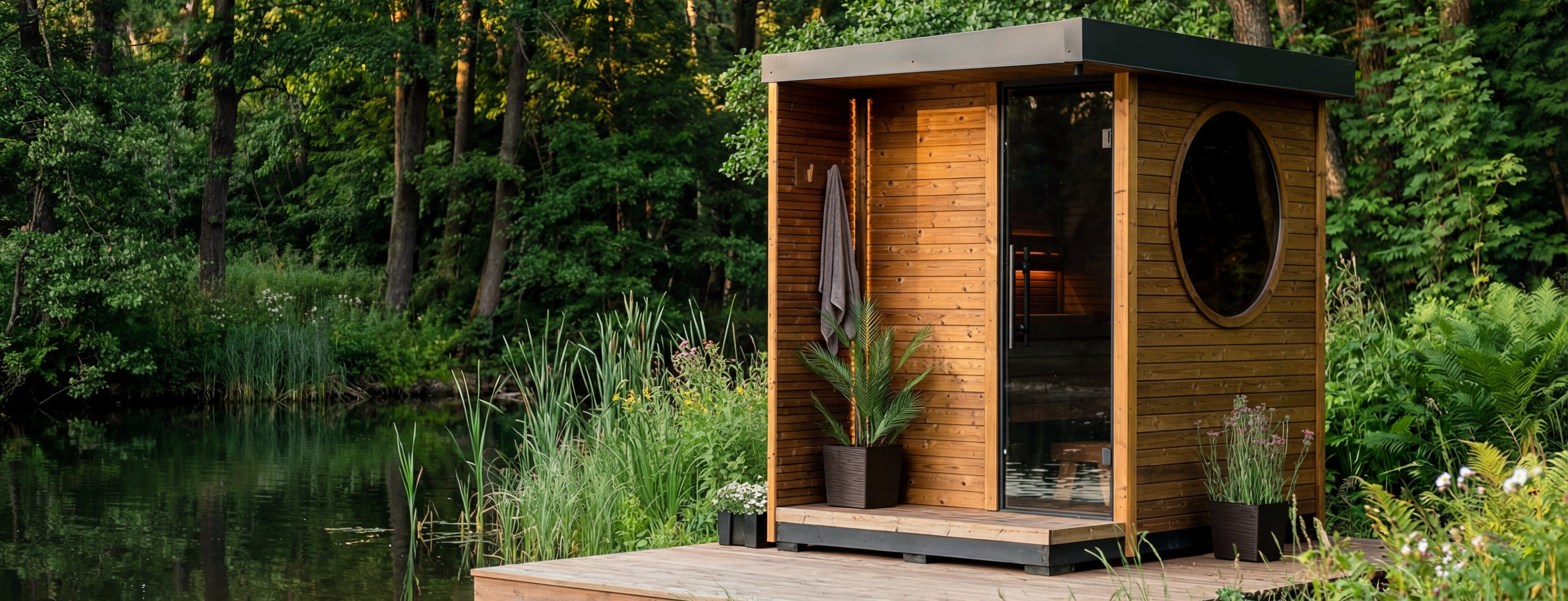
These are commonly referred to as sauna cabins. Whatever you call them, they have four walls and tend to look a little more modern. They’re also a bit more versatile.
Pros:
- Flat walls allow multi-tier bench layouts and L-shaped configurations with flexible seating
- Consistent headroom throughout the interior
- Can be fully insulated for cold-climate performance
- Works indoors and outdoors - basements, spare rooms, backyard builds
- More customizable with windows, glass doors, and exterior finishes
Cons:
- Longer heat-up time (45-60+ minutes) due to larger air volume
- Requires a proper foundation - concrete pad or reinforced deck
- Assembly is a weekend-to-multiday project, closer to building a small shed
- Permanent installation - not something you take with you
- Higher total installed cost when you factor in foundation work
Barrel Sauna vs Square Sauna: Side-by-Side Comparison
Here's how the barrel sauna vs square sauna comparison breaks down across the categories that matter most to someone trying to bring one of these into their home or yard.
|
|
Barrel Sauna |
Square Sauna |
|
Heat-up time |
30-45 minutes |
45-60+ minutes |
|
Heat distribution |
Natural convection via curved ceiling |
Can pool in upper corners without ventilation |
|
Insulation |
Typically uninsulated |
Can be fully insulated |
|
Bench layout |
1-2 tiers, curved seating |
Multi-tier, flat, L-shaped options |
|
Indoor use |
No (outdoor only) |
Yes (indoor and outdoor) |
|
Assembly time |
A few hours, 2 people |
1-3 days, 2-3 people |
|
Foundation |
Cradles on level surface |
Concrete pad or reinforced deck |
|
Portability |
Relocatable |
Permanent |
|
Maintenance |
Band tightening, exterior sealing |
Roof upkeep, exterior staining |
|
Best for |
Outdoor focal point, easier install |
Indoor/outdoor versatility, larger groups |
Heat Efficiency
The barrel shape wins on raw heat-up speed. It makes sense when you think about it - a cylinder has less total air volume than a rectangle of comparable dimensions. There is no wasted space in corners absorbing heat without actually moving the needle during a sauna session.
Hot air rises to the curved ceiling and rolls back down the walls in a continuous loop. Heat is more evenly distributed in a barrel than in a flat ceiling, where the hottest air just collects at the top.
What does this look like in practice? A traditional barrel sauna reaches target temperature in 30-45 minutes compared to 45-60 minutes for a comparable square unit.
Where square saunas fall short in heat-up times, though, they more than make up for it in heat retention. Most barrels ship with solid stave walls but no insulation layer. That's fine in mild climates. But an insulated square cabin holds heat way better over long sessions in Minnesota winters.
This is an important piece of context - the barrel vs square sauna heat question depends on where you live to some extent.
Space Considerations
Choosing between a barrel sauna vs square sauna comes down to internal space, too. Barrel saunas are compact by nature - the curved walls steal bench width on both sides, so a barrel rated for four people often seats two or three comfortably.
A 2-person barrel sauna is genuinely all you need if you're buying for yourself and a partner. Families typically land in the 4-person barrel sauna range. A 6-person barrel sauna gives you breathing room if you entertain guests or want room to stretch out.
In contrast, square saunas have more raw interior space at an equivalent footprint. Flat walls mean full-width benches and the ability to install multi-tier seating. You get to choose between higher (hotter) and lower (cooler) positions during a session. That's the traditional Finnish approach, and it makes a real difference in longer sessions.
Barrels are efficient on the footprint side, though. The cylindrical shape doesn't waste yard space on roof overhang or wall thickness. A square cabin of comparable capacity takes up more ground.
Speaking of space, you’ll want to think about where you plan to install the sauna. Barrel saunas are rare indoors. They’re more of an outdoor vibe. Cabin saunas, on the other hand, can be installed indoors OR outdoors without looking out of place. On that note…
The Aesthetic Side of Things
Barrel saunas look like nothing else in a backyard. The horizontal staves and curved profile are sculpturally stunning - part wine barrel, part Nordic retreat. The shape is distinct enough to create its own visual context in any landscape.
Add a barrel sauna with window and you get natural light flooding the interior while giving the exterior a design-forward edge. An outdoor barrel sauna in cedar is the kind of thing neighbors ask about and guests remember long after they’ve left.
Square saunas blend in by design, and that's not a weakness. A rectangular cabin matches the architecture of existing outbuildings. You get more flexibility with window placement and exterior finishes, too.
We like to say that square saunas lean a bit more modern and sleek, whereas barrel saunas are more rustic. There are, of course, exceptions with so many brands on the market today putting their own unique twist on sauna design.
Ease of Installation and Maintenance
This is one of the barrel sauna's clearest advantages. A barrel sauna kit for sale ships with pre-cut staves, circular end walls, and metal tension bands. Two people with basic tools can assemble one in a few hours - no framing, roofing, or foundation pour. Level the ground, set the cradles, and the rest is straightforward.
On the other hand, a square cabin is closer to building a small shed. That means wall framing and roof installation, plus insulation and a concrete pad underneath. Plan for a weekend at minimum.
Maintenance differs too. Barrel owners tighten the metal bands that hold the staves together as wood swells and shrinks with the seasons - maybe 15 minutes once or twice a year. Square sauna maintenance looks more like standard building upkeep: annual roof inspection and exterior sealing or staining, with occasional board replacement.
Which Sauna Style Fits Your Budget?
Barrel saunas tend to start lower at the entry level. The simpler foundation requirement alone saves hundreds compared to pouring a concrete pad for a square cabin.
The prices start to get a little closer at mid-range and premium capacity. A high-end 6-person barrel can cost as much as a comparable square cabin once wood species, heater quality, and accessories enter the picture.
The barrel vs square sauna budget decision is really about what sits on top of the base unit - electrical hookup, heater selection, and site prep all factor into the final number, no matter the shape.
Want some more specifics? Our most affordable barrel sauna model is $4,390. Our entry-level sauna cabin is $4,745. It’s not a massive difference until you realize the barrel sauna in question is actually bigger and higher-end.
Regardless, though, you can rest assured you’re getting the best deal online when you buy a sauna here on our website. We have a price match guarantee!
Your Search For a Barrel or Square Sauna Ends Here
We've helped over 900 customers find the right sauna - and the barrel sauna vs square sauna question is one we answer daily. We can do the same for you if you reach out.
Our catalog includes barrel saunas from SaunaLife, Dundalk Leisurecraft, and other top brands in sizes from a 3-person barrel sauna up to a 5-person barrel sauna and beyond. Every unit ships free with full manufacturer warranty.
If you've narrowed it down to barrel but want help choosing the right size, wood type, or heater configuration, call us at (833) 322-4836 - we're available 9 AM to 9 PM, seven days a week.
Bringing Our Barrel vs Square Sauna Comparison to a Close
The barrel sauna vs square sauna choice is really about priorities. Barrel saunas heat faster and install more easily, with an outdoor presence like no other style. Square saunas give you more interior space, insulation options, and work better indoors. They have their own modern flair.
Neither is objectively better, but one is almost certainly better for how you plan to use it. If you’re still on the fence between a barrel vs square sauna, get in touch today for one-on-one support!
Frequently Asked Questions
What are the benefits of a barrel sauna?
Faster heat-up time and natural heat circulation from the curved ceiling. Easier assembly. No permanent foundation needed, and you can relocate the unit if you move.
What are the disadvantages of a barrel sauna?
The curved walls eat into usable bench space. Most barrels are uninsulated, so cold-climate performance drops off compared to an insulated cabin. The tension bands need occasional tightening. And barrel saunas are effectively outdoor-only.
Is a barrel sauna better than a square sauna?
Barrel saunas have the edge for outdoor backyard use with easier installation and a quicker heat cycle. Square saunas are the stronger pick for indoor use or cold climates where insulation matters. The barrel sauna vs square sauna debate doesn't have a universal winner.
What is the best shape for a sauna?
Barrels win on heat efficiency and outdoor aesthetics, while square saunas take it on interior space and climate versatility. Most of our customers installing outdoors in temperate climates choose barrel. Those in colder regions or going indoors tend to go square.
Can I install a barrel sauna indoors?
Not usually. Barrel saunas are designed for outdoor use. The cradle system and curved profile assume an open-air setting.
Are barrel saunas portable?
More portable than square saunas since they sit on cradles without a permanent foundation. They can be disassembled and reassembled at a new location. Some smaller ones get crane-lifted intact.
Is a barrel sauna more beginner-friendly than a square sauna?
Yes. Stave-and-band kit assembly is simpler than framing a cabin, and the foundation prep is minimal - level ground and cradles versus pouring concrete. Operating either type is the same after installation, though.